Understanding something is not enough. We also need to embody it.
Perhaps you have known your patterns for a long time, yet still find that your body responds faster than any insight at key moments. For me, that is where body-oriented work begins.
Somatic Experiencing is a body-oriented approach developed by Dr Peter A. Levine for working with trauma and overwhelming experiences. The focus is on bringing awareness to the body and meeting whatever emerges with curiosity and openness.
02
How I use SE
In one-to-one sessions, I work with the approaches and methods I am learning as part of my SE training. We may begin with a specific experience or story and then direct our attention to what emerges in the body. We slow the process down, follow physical impulses and create space to notice sensations and emotions as they arise. Throughout, we allow sufficient time for integration, processing and reflection.
03
My training
I am in advanced Somatic Experiencing (SE) training with Dr Urs Honauer at the Centre for Inner Ecology (ZIO) in Zurich. Urs Honauer is one of Switzerland’s pioneers of Somatic Experiencing and has worked internationally as an SE trainer for many years. He is in regular professional exchange with Dr Peter A. Levine and collaborates with him on training and continuing education. Regular personal sessions and supervision are integral to my training and to my personal engagement with this method.
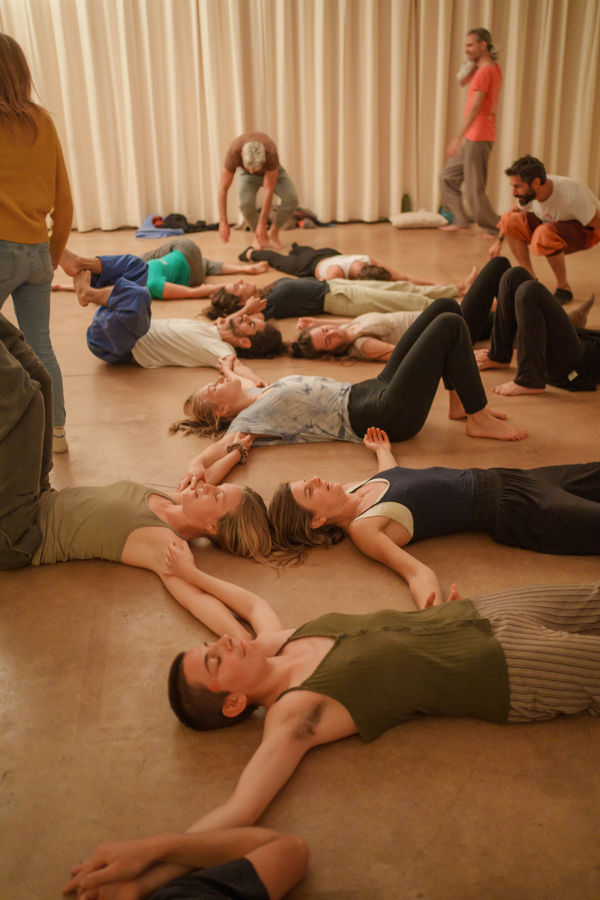
Shared body practice in a workshop
The processActivation · Regulation · Relationship
When rest does not feel safe.
Many people spend long periods in a state of high activation. Their system is geared towards performance, vigilance or action; pauses can feel unfamiliar, empty or even threatening. Some keep working despite being exhausted, find it difficult to stop, or continually seek intensity-through extreme exercise, speed or risk, for example.
It can feel as though the accelerator and brake are being pressed at the same time: the body mobilises energy while something else holds back or freezes. Over time, this requires a great deal of energy and can contribute to profound exhaustion.
Relaxation cannot simply be commanded. Sometimes it first takes a calm, reliable other person who does not push and who slows down with us. In this contact, the nervous system can experience: I do not have to perform right now; I can let the activation settle and remain safe. Over time, this experience of shared regulation can become more available when we are alone as well.
In my experience, I repeatedly see people finding themselves in very similar situations-as though drawn by an invisible pull: in relationships, conflicts, patterns at work or moments in which they once again exceed their own limits. This does not happen because they consciously choose these situations. I understand it instead as a sign that an old protective response is still caught in a loop and seeking a different resolution-an outcome that feels more coherent and safer this time.
In the body, this may be an impulse for movement that could not be completed at the time: turning away, fleeing, pushing back, raising the voice or orienting. In Somatic Experiencing, we notice such impulses, slow them down and give them space in small, safe steps. In this way, an automatic repetition can gradually become an experience with greater choice.
At the same time, we live in a culture that rewards speed, performance and constant availability. For me, Somatic Experiencing offers a counter-movement: not functioning faster, but perceiving more slowly; not overriding the body’s signals, but listening to them; not achieving even more, but finding connection, regulation and choice again at one’s own pace.
“The body’s time is much slower than the time of thought or feeling.”
These sessions are especially for people whose nervous system had to adapt early to a lack of safety, inconsistent closeness or too much responsibility. Later overwhelming experiences can also be given space.
You know this
Early on, you learned to read other people’s moods closely, adapt or put your own needs aside.
You long for closeness, yet notice that in relationships you still pull away, cling, become distrustful or lose yourself.
You often recognise what you need or where your boundary lies only late, sometimes not until your body responds with tension, exhaustion or withdrawal.
Criticism, conflict or fear of rejection trigger stronger responses in you than you can explain.
Even in safe situations, part of you remains alert. You may also be living with chronic pain, sleep problems or a diagnosed syndrome.
Conversation, yoga, meditation or other approaches have helped, yet under stress the same patterns return.
Or you have experienced an accident, fall, medical procedure or another suddenly overwhelming event and sense that it still reverberates in your body.
You want to
feel at home in your body again, safe enough to relax, feel and meet life.
allow closeness and receive love without losing yourself or giving up your boundaries.
show yourself in relationships, with your voice, your needs and your full vitality.
trust your own impulses, choose freely and act from an inner yes or no.
find your way back to joy, sensuality, play, creativity and genuine connection.
no longer merely function or survive, but shape your life from within.
integrate the past so that it no longer has to determine your present.
This is where my work can help
We listen to the body instead of trying to control it.
Somatic Experiencing works from the bottom up: the neocortex does not tell the body what should happen. We pay attention to impulses that arise on their own - such as moving away, setting a boundary, orienting or releasing tension - and give them space in small, manageable steps. This is the essential point: the body often already knows which movement or response is still missing. We do not need to control it, but to enable it to complete that response safely.
If this layer has been missing, a healing process may begin here: the body is no longer experienced only as a problem, but as a way into the connections behind symptoms, longing or dissatisfaction.
I do not want to offer you a ready-made picture of yourself. We explore together what emerges in your experience. That includes moments when something does not feel right, when you want to say no or when we need to take a step back.
You do not need to describe distressing experiences in detail, and not every response needs an immediate explanation. We pay attention to pace, resources and your ability to choose where your attention goes.
My support is not psychotherapy and does not replace medical or psychotherapeutic treatment. In an acute crisis, or if you need diagnostic or clinical care, an appropriately qualified professional is the right first contact.
Contact
If you feel ready to explore this layer of experience.
Tell me what is on your mind or what you feel has been missing from your work with yourself so far. We can see whether a session with me would be a good fit.